
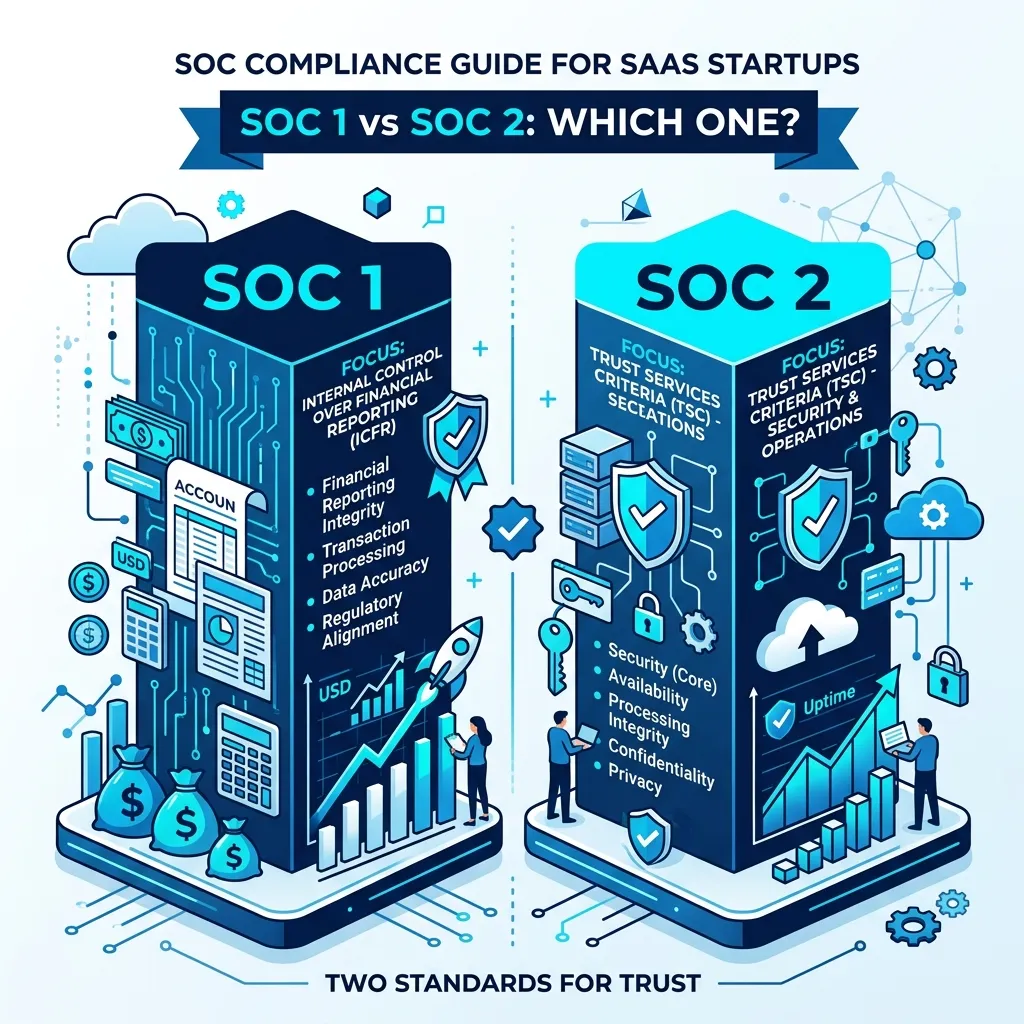
For growing Software-as-a-Service (SaaS) startups, navigating compliance requests can feel like deciphering alphabet soup. As you move upmarket to secure enterprise clients, you will inevitably see procurement contracts requesting one of two options: a SOC 1 or a SOC 2 report.
Many founders assume these reports are interchangeable, or they aren’t sure which audit scope actually matches their business model. Choosing the wrong framework leads to wasted capital, duplicate engineering effort, and delays in closing deals.
Here is a practical, CPA-led guide comparing SOC 1 vs. SOC 2, specifically written to help SaaS startups choose the right compliance path.
The Core Difference: Scope and Intent
The easiest way to distinguish between the two reports is to look at what the auditor is evaluating:
- SOC 1 focuses on controls that affect your customers’ financial reporting.
- SOC 2 focuses on controls that affect your systems’ security, operational integrity, and data privacy.
Let’s break down each report in detail.
SOC 1: Financial Controls Focus
A SOC 1 report (formally an Audit of Controls at a Service Organization Relevant to User Entities’ Internal Control Over Financial Reporting or ICFR) is based on the SSAE 18 auditing standard.
If your SaaS platform processes billing data, executes financial transactions, calculates pension benefits, manages payroll, or administers funds, your clients’ internal finance and audit teams need assurance that your calculations are accurate and tamper-proof.
When does a SaaS startup need a SOC 1?
You typically need a SOC 1 report if:
- Your software processes financial transactions on behalf of clients (e.g., payment gateways, fintech ledgers, equity management software).
- Your calculations feed directly into your clients’ financial ledgers or general ledgers.
- Your platform manages client billing or invoicing calculations that are material to their financial statements.
SOC 2: Security & Operations Focus
A SOC 2 report (formally an Attestation on Controls at a Service Organization Relevant to Security, Availability, Processing Integrity, Confidentiality, or Privacy) is based on the AICPA’s Trust Services Criteria.
This is the standard, default compliance framework for SaaS companies, cloud providers, and IT vendors. Rather than inspecting financial calculations, the auditor evaluates whether you have robust operational controls to secure customer data, maintain system uptime, and prevent breaches.
When does a SaaS startup need a SOC 2?
You need a SOC 2 report if:
- You handle, store, or transmit sensitive customer data in the cloud.
- You sell subscription software to mid-market or enterprise companies with strict IT security questionnaires.
- Your contract terms require independent verification of your data security practices.
Can a Startup Need Both?
Yes. In some procurement cycles, enterprise buyers will ask for both reports. This is common for SaaS platforms that handle sensitive financial transactions (requiring SOC 1 for transaction accuracy) and run entirely in the cloud (requiring SOC 2 for host security).
If you need both, do not pay for two separate preparation cycles.
By executing a unified SOC readiness assessment, you can map your controls to both SSAE 18 (financial controls) and the Trust Services Criteria (security) at the same time. Based on anonymized Expert Insights mapping engagements completed between January 2024 and December 2025 for US-based SaaS startups ranging from 10 to 150 employees, we observed that approximately 68% of the core IT general controls (ITGCs) established for logical access, change management, and operational backups map directly to both the AICPA Trust Services Criteria (for SOC 2) and the financial transaction control baselines (for SOC 1). Preparing for both simultaneously saves your engineering team significant time and keeps audit fees manageable.
How to Get Started
If you are a SaaS founder planning your compliance roadmap, start by reviewing your current enterprise sales pipeline:
- Check Your Contracts: Look at your pending deal terms or vendor security questionnaires to see which report is specifically requested.
- Undergo a Readiness Check: Before contracting an auditor, run a structured SOC readiness assessment to surface gaps in your policies, access controls, or onboarding processes.
- Plan Your Observations: Use your readiness roadmap to remediate gaps, ensuring that when the formal audit begins, your controls have historical evidence ready to inspect.
If you have questions about system scope or which report fits your platform, reach out to Expert Insights to discuss your business with our CPA-led compliance advisors.