
Last Reviewed & Updated: June 22, 2026 by Alina Archibald, CPA, CISA, CITP
When SaaS startups and service providers start planning their compliance roadmap, the first question they typically ask is: How much does a SOC 2 audit cost?
Because a SOC 2 examination is an independent CPA attestation rather than a standard software certificate, pricing varies widely based on organizational scope, system complexity, and prep methodology. To compete in today’s market, businesses need a transparent pricing breakdown that goes beyond simple generic ranges.
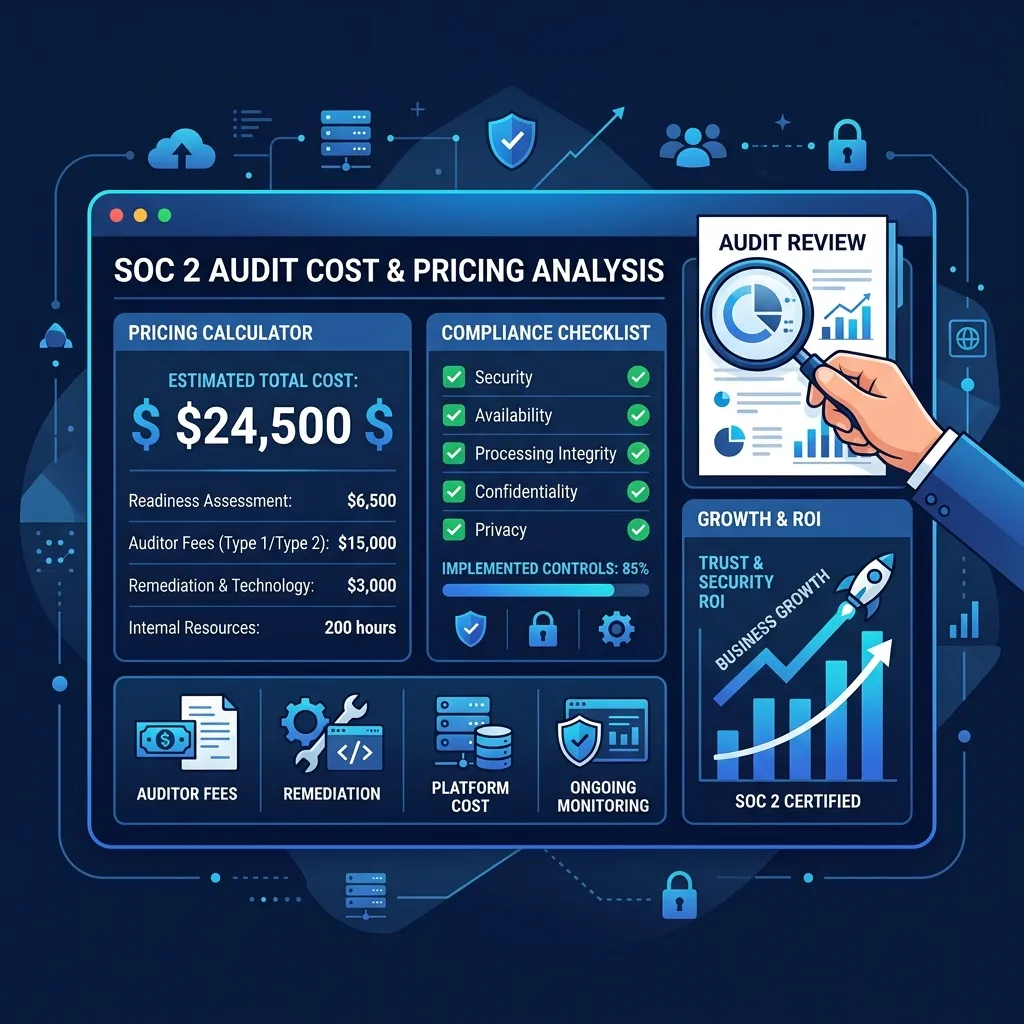
Below, we detail the primary cost categories, a side-by-side Type I vs. Type II comparison table, cost structures mapped by company size, a real-world case study, and an interactive pricing calculator to help you estimate your compliance budget.
1. Transparent Pricing Methodology
SOC 2 audit pricing is determined by four key variables:
- Audit Scope (Trust Services Criteria): The AICPA defines five Trust Services Criteria (TSC) 1. Auditing only the mandatory Security criteria (Common Criteria) is significantly less expensive than auditing all five (Security, Availability, Confidentiality, Processing Integrity, and Privacy).
- Audit Type: A Type I audit evaluates your control design at a single point in time, whereas a Type II audit evaluates control design and operational effectiveness over a 3-to-12 month observation window 2.
- Infrastructure Complexity: The number of cloud environments (AWS, GCP, Azure), database instances, SaaS integrations, physical office locations, and employees directly increases the auditor’s sampling size and review time.
- Remediation Maturity: Organizations starting from scratch require heavier investment in writing policies, implementing controls (like MDM or centralized logging), and advisory services compared to teams with mature controls.
2. Scope Variables and Example Scenarios
To illustrate how these variables impact costs, consider these three typical scoping scenarios:
- Scenario A (Security Only Startup): A 12-employee SaaS firm running on AWS, using one identity provider, and auditing only the Security criteria. Low complexity.
- Scenario B (Multi-Criteria Growth): A 45-employee fintech firm with multiple integrations (Slack, GitHub, Jira), using both AWS and Heroku, auditing Security, Availability, and Confidentiality. Moderate complexity.
- Scenario C (Complex Mid-Market): A 150-employee healthcare service provider with two office locations, multiple database servers, auditing all five Trust Services Criteria (including Privacy due to HIPAA considerations). High complexity.
3. Type I vs. Type II Cost Comparison
To budget effectively, you must separate compliance costs into distinct categories: readiness advisory, automation software, CPA audit fees, remediation tooling, and internal employee labor.
| Cost Category | SOC 2 Type I | SOC 2 Type II (6-Month Observation) |
|---|---|---|
| 1. Pre-Audit Preparation (Readiness) | $8,000 – $12,000 | $10,000 – $18,000 |
| 2. Compliance Platform Licensing | $5,000 – $8,000 / yr | $8,000 – $15,000 / yr |
| 3. CPA Audit Examination Fee | $12,000 – $18,000 | $18,000 – $35,000 |
| 4. Remediation Tooling & Licensing | $1,500 – $3,000 | $3,000 – $8,000 |
| 5. Internal Labor (Estimated Value) | 40 – 60 hours ($3k – $5k value) | 80 – 120+ hours ($6k – $10k value) |
| Total Cash Budget (Excl. Labor) | $26,500 – $41,000 | $39,000 – $76,000 |
Note: Pre-audit readiness and CPA audit fees reflect typical regional mid-market CPA pricing. Platform licensing represents third-party software licensing averages. Remediation tooling includes software additions like Mobile Device Management (MDM) or security logging licenses.
4. Cost Matrix by Company Size & Complexity
Compliance costs scale predictably with employee count and system complexity. Based on first-party market data, organizations fit into three main budgeting tiers:
Startup Tier (under 20 employees)
- Profile: Single cloud application, simple infrastructure, Security criteria only.
- Readiness Method: Compliance software + light CPA advisory.
- Average Budget (Type I): $28,000 – $35,000
- Average Budget (Type II): $42,000 – $52,000
Growth Tier (20 – 100 employees)
- Profile: Multiple SaaS integrations, Security + Availability + Confidentiality.
- Readiness Method: Automation platform + hands-on CPA advisory.
- Average Budget (Type I): $36,000 – $48,000
- Average Budget (Type II): $55,000 – $75,000
Mid-Market Tier (100+ employees)
- Profile: Multi-cloud infrastructure, strict SLA commitments, complex HR policies, auditing all 5 TSCs.
- Readiness Method: Dedicated enterprise platform + continuous CPA advisory.
- Average Budget (Type I): $50,000 – $70,000
- Average Budget (Type II): $78,000 – $120,000+
5. Anonymized Real-World Case Study
Case Study: 35-Employee Fintech SaaS Platform (Growth Tier)
- Scope: Security, Availability, and Confidentiality criteria over a 6-month Type II observation window.
- Infrastructure: AWS hosting, GitHub for code management, Okta for identity management, and Jira for change tracking.
- Actual Spend Breakdown:
- Pre-Audit Readiness & Advisory: $12,500 (Expert Insights)
- Compliance Automation Platform: $9,000 (annual license)
- CPA Audit Examination Fee: $24,000 (Type II)
- Remediation Tooling: $3,200 (MDM licenses and backup logging tooling)
- Internal Staff Hours: 65 hours total engineering/operations effort.
- Total Financial Investment: $48,700
- Outcome: The organization achieved a clean SOC 2 Type II report with zero exceptions, successfully closing a critical enterprise contract worth $180,000 in annual recurring revenue within 30 days of report issuance.
6. Interactive SOC 2 Cost Estimator
Use the calculator below to get an instant, customized cost estimation for your company’s compliance project.
Interactive SOC 2 Cost Estimator
Select your business parameters to calculate a tailored readiness, platform, audit, and labor cost estimate.
Estimated Budget Breakdown
7. Actionable Tips to Optimize Your SOC 2 Budget
You don’t need to overspend to get a rigorous, high-quality report that satisfies your enterprise buyers. Here is how to keep costs manageable:
Define Your Scope Intentionally
Do not audit system segments or Trust Services Criteria that your clients do not care about. Start with the Security criteria (often called the Common Criteria), which is the mandatory baseline. Only add Availability, Confidentiality, Processing Integrity, or Privacy if they are explicitly required by your contract terms.
Start with a Type I, Then Move to Type II
If you have a tight deadline and a limited budget, pursue a SOC 2 Type I report first. A Type I audit takes less time, costs less in auditor fees, and establishes your baseline. Once issued, you can immediately begin your Type II observation period with your controls already validated.
Partner with a Regional Midwest Firm
National compliance firms located on the coasts carry massive corporate overhead and metropolitan billing rates. Collaborating with a Midwest-based, CPA-led advisory firm rooted in Springfield, Chicago, or St. Louis provides the exact same high-level assurance while eliminating premium city rates and travel expenses.
8. Get a Custom Scoping & Cost Estimate
Need help estimating your exact SOC 2 budget? Let’s map your system boundaries and build a tailored cost worksheet.
Request a Custom Cost Assessment
Citations and References
Footnotes
-
AICPA. Trust Services Criteria for Security, Availability, Processing Integrity, Confidentiality, and Privacy. AICPA TSC Guidelines. ↩
-
AICPA. Statement on Standards for Attestation Engagements No. 18 (SSAE 18). AICPA Attestation Standards. ↩