
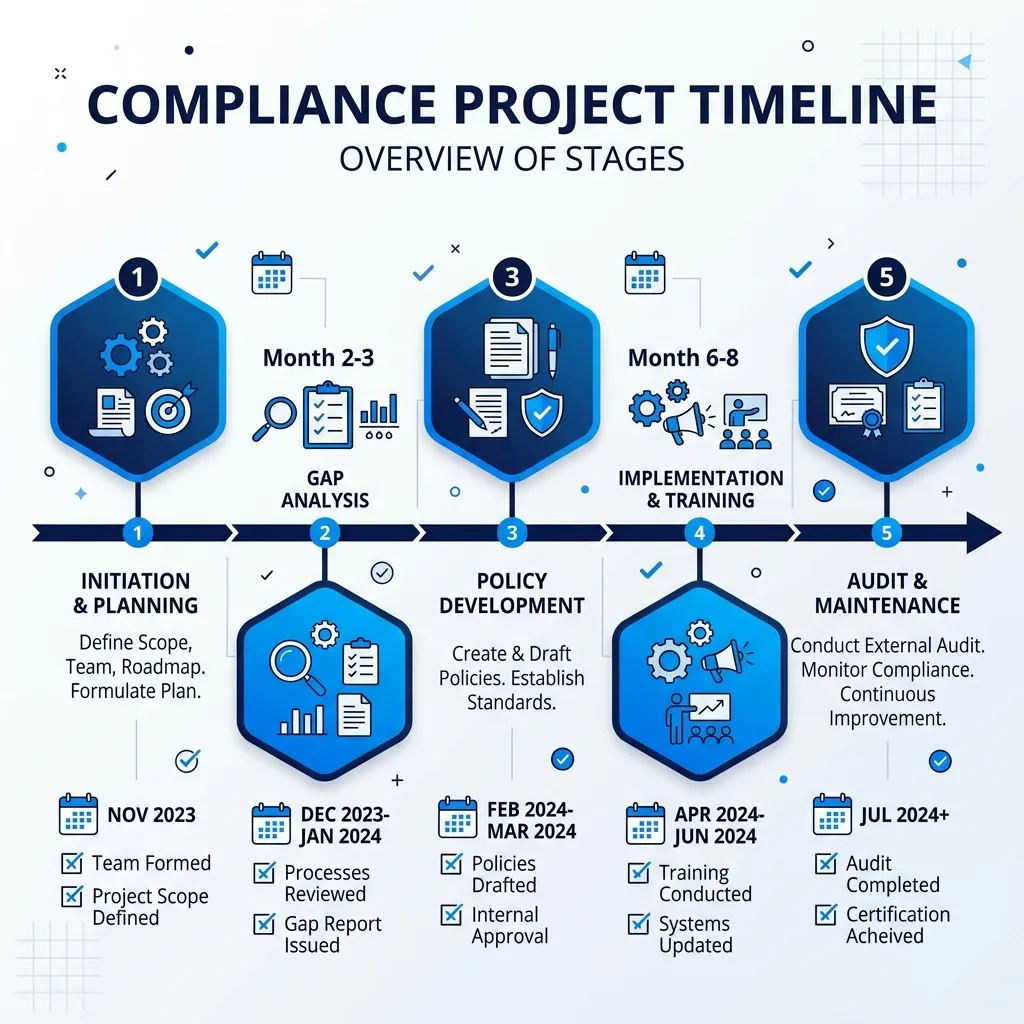
When planning a SOC 2 compliance audit, one of the first questions leadership teams ask is: How long is this going to take?
A typical SOC 2 timeline ranges from 2 to 9 months, depending on your existing security controls, technical complexity, and whether you are pursuing a Type I or Type II report. Treating this as a rushed project often leads to audit findings, qualified opinions, or expensive operational bottlenecks.
A successful SOC 2 project requires a structured milestone plan. Here is a breakdown of the phases, milestones, and deliverables involved in a standard SOC 2 audit timeline.
The Four Phases of a SOC 2 Audit
Phase 1: Gap Assessment & Scoping (Weeks 1 – 3)
The goal of this initial phase is to define the boundaries of your “system” (the software, infrastructure, people, and processes that handle client data) and map your existing security controls against the AICPA Trust Services Criteria (TSC) (review our SOC 2 Evidence Checklist by Trust Services Criteria to see what exact configurations and artifacts the auditor will request).
- Milestone 1: Define system boundaries and select applicable Trust Services Criteria (Security is mandatory; Availability, Confidentiality, Processing Integrity, and Privacy are optional).
- Milestone 2: Conduct a gap analysis to identify missing policies, unconfigured logging tools, or lack of structured operational reviews.
- Deliverable: A prioritized Remediation Matrix detailing exactly what gaps must be resolved before formal testing begins.
Phase 2: Remediation (Weeks 4 – 10)
Remediation is usually the most labor-intensive phase of the timeline. This is where you address the gaps identified in Phase 1.
- Milestone 3: Draft and adopt formal security policies (e.g., Access Control, Change Management, Incident Response).
- Milestone 4: Configure technical controls, such as enforcing Multi-Factor Authentication (MFA) across all identity providers, enabling local drive encryption via MDM, and configuring centralized log aggregation.
- Milestone 5: Establish recurring operational workflows, such as conducting background checks for new hires, scheduling vulnerability scans, and establishing a risk assessment committee.
Phase 3: Observation Period (3 to 12 Months)
For a SOC 2 Type II report, auditors do not just test your systems at a single point in time. They must evaluate how consistently your controls operated over a historical window—typically 6 months for a first-time audit (see our SOC 2 Type I vs. Type II comparison to understand when to choose a point-in-time vs. historical audit).
- Milestone 6: Initiate formal observation. All changes, access requests, and backups must generate a consistent, unbroken audit trail from Day 1 to the end of the period.
- Milestone 7: Conduct a mid-period check to review sample pull requests, backup logs, and onboarding files to catch any control failures early.
Phase 4: Fieldwork & CPA Examination (Weeks 10 – 14 post-observation)
Once the observation period closes, the independent CPA firm begins formal fieldwork (refer to our checklist on how to choose a SOC auditor for screening candidate CPA firms).
- Milestone 8: Auditor sends a document request list (DRL). You upload screenshots, configurations, and logs proving controls operated consistently.
- Milestone 9: CPA team conducts walkthrough interviews, tests selected samples, and drafts the report.
- Milestone 10: Receive the final SOC 2 attestation report expressing the independent auditor’s professional opinion.
Detailed Project Timeline Summary
| Phase | Est. Duration | Core Focus | Key Milestone |
|---|---|---|---|
| 1. Scoping & Gap Analysis | 2–3 Weeks | System mapping & TSC selection | Gap Remediation Matrix |
| 2. Remediation | 4–8 Weeks | Drafting policies & system configs | Branch protections & MFA active |
| 3. Observation Period | 6 Months (Type II) | Maintaining consistent control logs | Mid-period sample checks |
| 4. CPA Fieldwork | 3–4 Weeks | Evidence testing & walk-throughs | Report delivery |
Strategic CTA for Compliance Teams
If you are beginning your compliance planning, scheduling a scoping assessment early is critical. Having a licensed practitioner review your system boundaries before starting remediation saves months of wasted engineering effort.
Learn how we help you map controls and prepare for a successful examination: Expert Insights SOC 2 Compliance Services.